Jillian's Aboriginal project

Aborigines use the names applicable to their own groups. They are likely to call themselves by the name of the language or territory group to which they belong, for example, Wiradjuri, Pitjantjatjara, Kamilaroi, Gurnai, Aranda.
They may also use a general term like Murri, Koori, Nunga, Nyoongah or Yolgnu. Torres Strait Islanders use the name of their island community to describe themselves, for example, Badu, Murray, Yam, Boigu. The Torres Strait Islands lie in the Torres Strait which is the stretch of water that separates Cape York Peninsula in north Queensland from Papua New Guinea.
Throughout the 50,000 years or more that Aboriginal people have been on the continent, they have had to adapt to dramatic changes in their environment caused by variations in climate and movement of landmasses. Wooden tools rarely survive in the earth, but we know from one unique archaeological find that the boomerang (and the barbed spear) was invented more than 10,000 years ago.
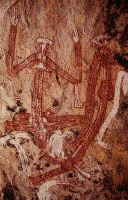
Rock art shows changes in wooden tools and such other perishable items as headdresses. Around 5,000 years ago there was even a radical change in the stone tools themselves, with small, delicately worked points and blades beginning to be produced. This change may have been associated with the use of composite tools, that is, with points used on a spear in place of a sharpened wooden end.
Throughout the ancient history of the Aboriginal people there were many changes more important than technological ones. Many different styles of rock art appeared in different regions and changed over time, from the stylised, symbolic ancient engravings to the colourful X-ray art of the north and the vivid hunting scenes of east and west. Together with changes in burial practices, such differences undoubtedly reflect changing religious beliefs and rituals.
As Australia approaches the 21st century we are only just beginning to recognise the importance of Aboriginal Sites as part of our Cultural heritage. Aboriginal people have always know the importance of these sites to their existence.
They serve as reminders of why we need to preserve and protect all facets of heritage Over the past 200 years many Aboriginal sites have been lost, denying future generations valuable insight into a culture that different governments and government policies has tired to kill off. Much damage has been done through ignorance and deliberate vandalism.
Over the past 50 years a lot of sites in this area land of Dharug have been lost in the name of progress. The sites in my local area like sites all over Australia serve to remind us that Australia has an Aboriginal history which goes back over 145000 years.
These are over 700 sites in my local area which remind us that there is a history other than the white conquest of the land. The sites are important because they show that Aboriginal people have a rich culture, and a history recorded in the earth as the soul of our Aboriginal people and is a recognisable symbol of our identity. These sites provide a link back to the dreaming. The sites show non Aboriginal and archaeological that Aboriginal have a social, economic cultural and spiritual heritage.
They also provide windows on the past from which we can all learn to begin to understand.
In Dharug my local area there are about 700 identified sites and these range from work sites to sites of great religious and ceremonial importance. These sites are also of value as archaeological sites as they document and sustained history of Aboriginal occupation over 40,000 years.
There are mythological sites, ceremonial sites. open air sites of campsites, workplaces, burial grounds and past contact sites. Most of these also fall in the category of being an archaeological sites.
Often Aboriginal of different groups would meet at these grounds. For instance it is believed that the Gundungurra and Dharug people meet in areas of the Blue Mountains, around present day Glenbrook for joint ceremonial purposes.
There are many sites scattered through out that are testimony to the ceremonial sites are usually marked by Bora rings. A Bora ring is the name given to a raised platform of circular dirt.
Over 40% of cave paintings, 6% of rock engravings and stone arrangement fall into one area of the Central Blue Mountains, leading many to believe that this was a ceremonial area.
Ceremonial sites can also be identified by rock engravings. In the Blue Mountains there are 57 documented sites. Most are centred in the Central area on the ridge line running North and South of Woodford. Linden veering East towards Glenbrook.
This area appears to have had ceremonial activity. Engravings required more time to complete and also it is believed that they had scared significance playing a major part in ritual - as the reworking of the lines may be in conjunction with the initiation stories.